Hogwarts Board of Governors
The Hogwarts Board of Governors is the governing body of Hogwarts School of Witchcraft and Wizardry, a twelve-member council with the authority to appoint or suspend the headmaster. In Harry Potter and the Chamber of Secrets, the Board becomes a pivotal force in the school's governance, wielding its power to remove Albus Dumbledore at the height of a crisis, only to be compelled to restore him when the true culprit is exposed. The Board's actions reveal the political vulnerability of Hogwarts to external influence, particularly through the machinations of Lucius Malfoy, a governor who uses his position to advance a pure-blood agenda.
Composition and Authority
The Board of Governors is a body of twelve individuals who hold ultimate authority over the headmaster's tenure. Their power is demonstrated when Lucius Malfoy presents an Order of Suspension bearing all twelve signatures, forcing Dumbledore to step aside. The Board's role in appointing and suspending the headmaster is explicitly stated by Malfoy: "The appointment — or suspension — of the headmaster is a matter for the governors." This authority is exercised without the consent of the Ministry of Magic, as Cornelius Fudge, the Minister, is taken aback by the suspension, exclaiming, "Dumbledore suspended — no, no — last thing we want just now." The Board's decisions are thus independent of ministerial oversight, making it a powerful and potentially partisan body.
Role in the Chamber of Secrets Crisis
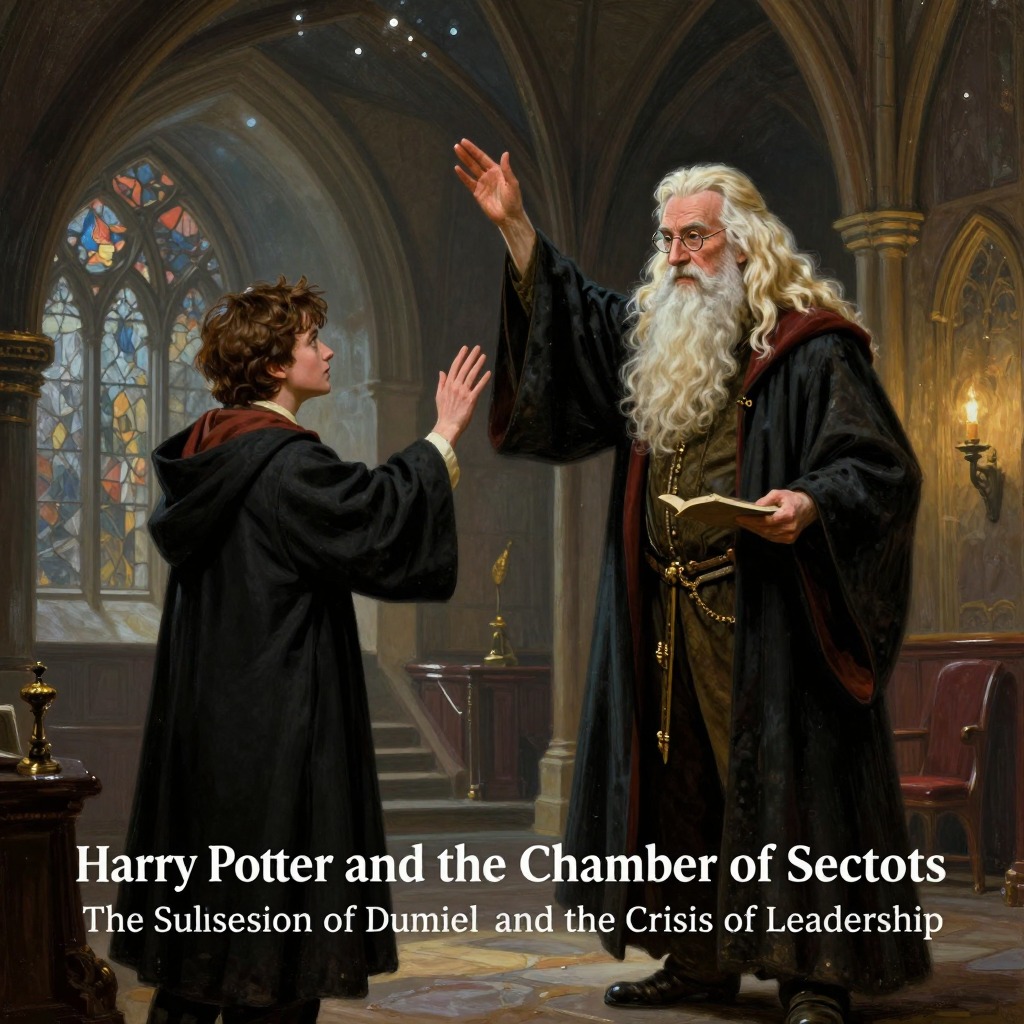
The Board's involvement in the crisis begins when the attacks on Muggle-born students escalate. After the second double attack on Justin Finch-Fletchley and Nearly Headless Nick, the Board, under Malfoy's influence, decides to suspend Dumbledore, holding him responsible for failing to stop the attacks. Malfoy delivers the Order of Suspension to Dumbledore in Hagrid's hut, accompanied by Cornelius Fudge, who has come to arrest Hagrid. Malfoy's satisfaction is evident as he declares, "Dreadful thing, Dumbledore, but the governors feel it's time for you to step aside." The suspension leaves Hogwarts under the temporary leadership of Minerva McGonagall, who is described as "only filling in." The Board's action emboldens Draco Malfoy, who gloats that his father might become the one to rid the school of Dumbledore permanently.
The Board's Reversal and Aftermath
Following the resolution of the crisis—when Harry Potter destroys Tom Riddle's diary and defeats the basilisk—the Board reverses its decision. Dumbledore reveals that "the other eleven governors contacted me today," having heard that Arthur Weasley's daughter had been killed and wanting him back at once. They now believe Dumbledore is "the best man for the job after all." Dumbledore also discloses that several governors claimed Malfoy had threatened to curse their families if they did not agree to suspend him in the first place, exposing the coercion behind the Board's earlier action. As a consequence, Lucius Malfoy is sacked as a school governor, and Draco Malfoy loses his swaggering confidence. The Board's reinstatement of Dumbledore restores stability to Hogwarts, but the episode underscores the fragility of the school's governance when subjected to political manipulation.
Significance
The Board of Governors represents the intersection of power and prejudice within the wizarding world. Its susceptibility to Malfoy's threats and its willingness to suspend a beloved headmaster illustrate how institutional authority can be corrupted by personal vendettas and pure-blood ideology. The Board's actions also highlight the importance of loyalty and choice, as Dumbledore's eventual restoration reaffirms the values of the school over the machinations of its governors. The Board's role in the narrative serves as a cautionary tale about the dangers of unchecked governance and the need for integrity in positions of power.